Description of Assignment
During this internship, you will develop a portal for managing an electric vehicle fleet. The aim is to enable vehicles to be assigned to charging points securely and efficiently. Both employees and fleet managers must be able to access relevant information and functionality through the portal. The Ping Identity Platform will be used as the IAM solution, with a focus on identity managed objects, role management and delegated authentication.
What will you do?
- Design and develop a portal where employees and administrators can sign in and manage the vehicle fleet.
- Implement a registration flow that allows employees to dynamically register their account and vehicle.
- Provide delegated authentication through the Ping Identity Platform.
- Design and implement role-based access control so that administrators can manage vehicles, charging points and user accounts.
- Simulate vehicles through a client application that initiates charging sessions.
- Document the entire process and explain how it could be applied in a production environment.
Data model guidelines
The diagram below shows the basic structure we expect to see in every solution. It contains only the objects, their key fields and the multiplicity of the relationships. You will determine types, uniqueness constraints, required fields, deletion rules and any additional objects during your analysis.
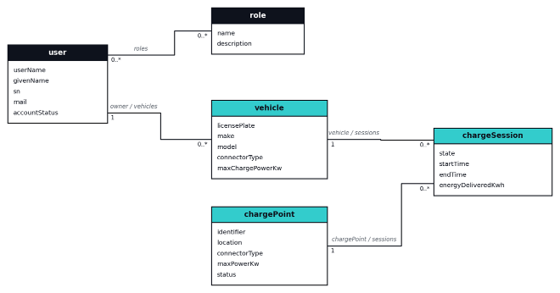
- Model everything as a managed object in IDM. Define links between objects using relationships.
- Start with the built-in managed/user and managed/role objects. Assign permissions through roles.
- Explain and justify any deviations from this structure in your analysis.
What technical skills will you learn?
- Working with the Ping Identity Platform and IAM concepts.
- Applying federation protocols such as OAuth 2.0, OIDC and SAML.
- Developing secure applications with a focus on authentication and authorisation.
- Implementing role-based access control and identity managed objects.
- Simulating and integrating client applications in a secure environment.
What soft skills will you develop?
- Communication skills: reporting and documenting clearly and professionally, and collaborating with colleagues and stakeholders.
- Collaboration: working effectively within a multidisciplinary team in an agile environment.
- Problem-solving: analysing technical challenges and resolving them independently or in consultation with others.
- Self-organisation: taking responsibility for your tasks, planning and progress.
- Critical thinking: substantiating your choices and continuously improving based on feedback and evaluation.
- Customer focus: considering user needs and the business context when designing solutions.
Project Methodology
- The internship assignments follow the Scrum project methodology to provide a structured and efficient approach to tasks and subtasks.
- This reflects IdentIT’s approach to projects.
- Scrum is a flexible framework that:
- Promotes collaboration
- Encourages adaptability
- Ensures transparency.
- The work is organised into time-boxed iterations called sprints:
- Each sprint lasts 2 to 3 weeks.
- Each sprint has clear objectives and tasks.
- At the start of each sprint:
- The intern(s) and supervisor(s) hold a sprint planning session.
- The objectives are defined.
- A sprint backlog is created.
- During the sprint:
- Weekly stand-up meetings are held.
- Progress is discussed.
- Any obstacles are identified and addressed.
- At the end of each sprint:
- A sprint review is held.
- Where possible, a demo is given.
- Feedback is collected.
- Scrum contributes to a collaborative and adaptable working environment.
- The aim is to achieve the best possible results within the given timeframe.
MVP
The minimum feature set we expect is:
- A portal with Ping-based sign-in functionality for employees and administrators.
- The ability for employees to register their vehicle.
- Administrators can manage vehicles, charging points and users through a separate management interface (view) in the application.
- A simulation of vehicles initiating charging sessions through a client application.
Expected Outcomes
The following deliverables are expected at the end of the assignment:
- A technical analysis of the problem.
- The architecture of the required components.
- The MVP and any additional features.
- A demo of the end-to-end solution.
- Documentation of the entire process.